One pair of dumbbells, 30 minutes, and your whole body gets worked. That’s what you’re getting in this full body dumbbell workout at home.
I’ll walk you through five exercises, one for each basic movement your body does. Then I’ll show you how to set the sets, reps and rest, and how to make it harder when the weight starts feeling light.
Grab your dumbbells and clear a space about the size of a yoga mat. Let’s start.
[On screen: One pair of dumbbells. Five movements. 30 minutes.]
What one pair of dumbbells can and can’t do for you
One pair of dumbbells can train every major muscle group. Legs, back, chest, shoulders, arms and core all get work if you pick the right exercises.
There are two limits. First, one weight is always a compromise. A pair that feels right for an overhead press will feel light for squats and deadlifts, because your legs are stronger than your shoulders. Second, pulling is harder to load at home without a bar to hang from, so we’ll lean on rows.
Both limits are workable. Slower reps, pauses and single-leg variations make a light weight feel heavier, and I’ll cover them near the end.
[B-roll: a single pair of dumbbells on the floor of a small room]
If you’re still buying, choose a pair you can press overhead for about eight to ten controlled reps. Adjustable ones save you from buying again later, but a fixed pair works fine.
The five movement patterns that cover your whole body
Instead of memorizing a list of exercises, learn five patterns: squat, hinge, push, pull and carry.
A squat bends your knees and hips together. A hinge bends mostly at the hips while your back stays flat. A push moves weight away from your body. A pull brings weight toward you. A carry makes you hold weight and stay upright while you move or resist moving.
Together these cover nearly everything you do in daily life, like standing up, picking things off the floor, lifting a bag, opening a door and carrying shopping.
This matters for a practical reason. If you ever get bored of one exercise, swap it for another in the same pattern and the routine still covers your whole body.
Squat: goblet squat and how to set your depth
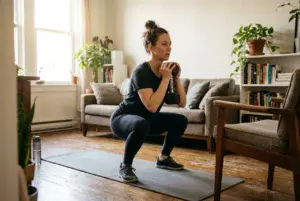
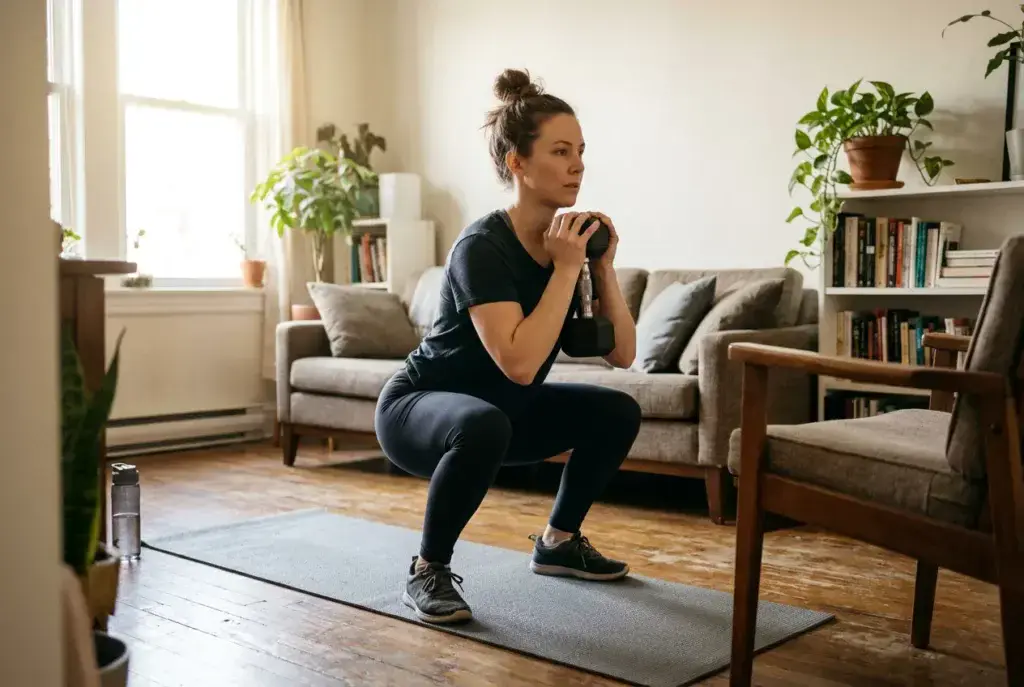
Hold one dumbbell vertically against your chest, with both hands cupped under the top end. Keep your elbows pointing down.
Stand with your feet a little wider than your hips and your toes turned slightly out. Sit down between your knees, keeping your chest tall. Then push the floor away to stand.
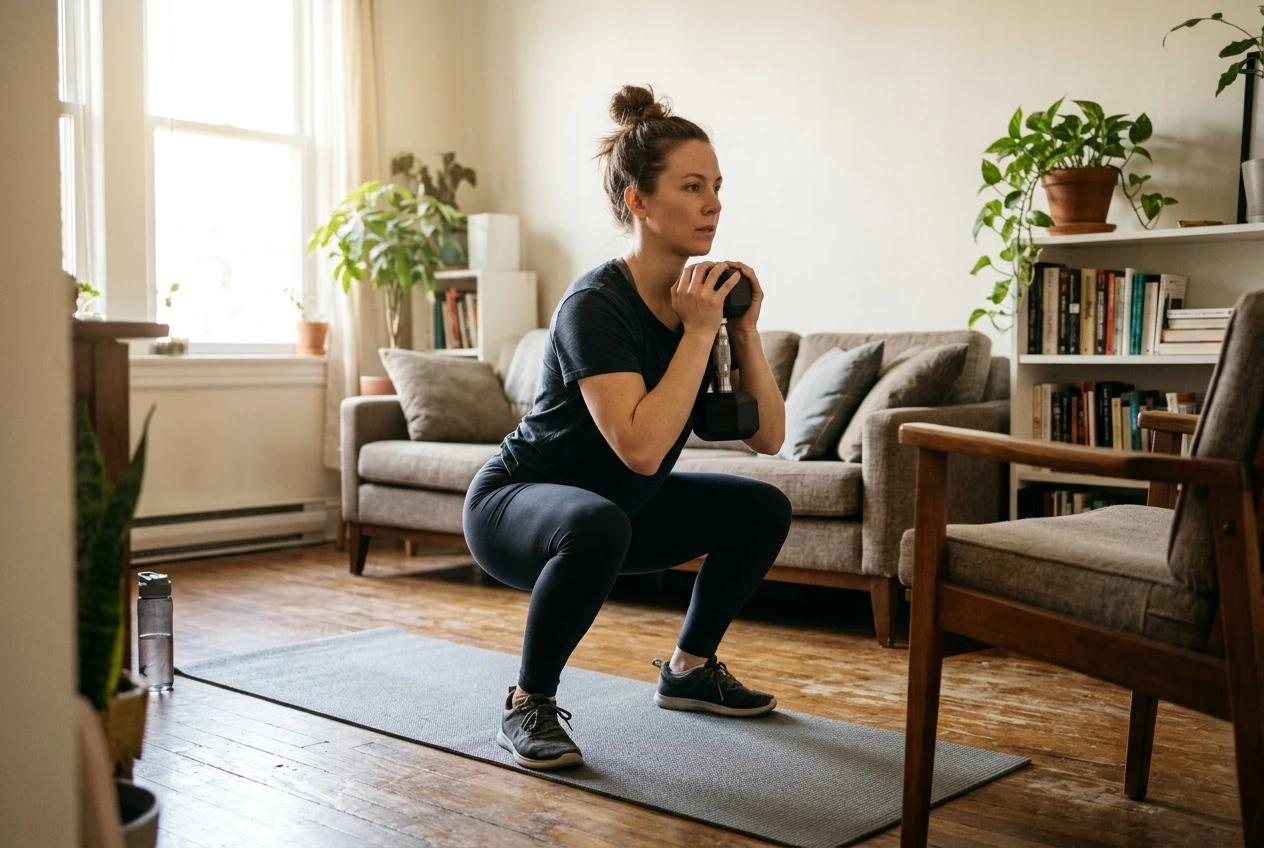
For depth, go as low as you can while your heels stay flat and your back stays straight. If your lower back starts to round at the bottom, you’ve gone past your depth for today. Stop a little higher.
If you want a guide, sit down onto a chair and stand back up, touching it lightly without relaxing. Over a few weeks, the depth usually improves.
Hinge: Romanian deadlift and keeping your back flat
Hold a dumbbell in each hand in front of your thighs, with your palms facing you. Stand with your feet about hip width apart and your knees slightly bent.
Now push your hips straight back, like you’re closing a car door with your backside. The dumbbells slide down your thighs toward your shins. Your knees stay softly bent and don’t change much.
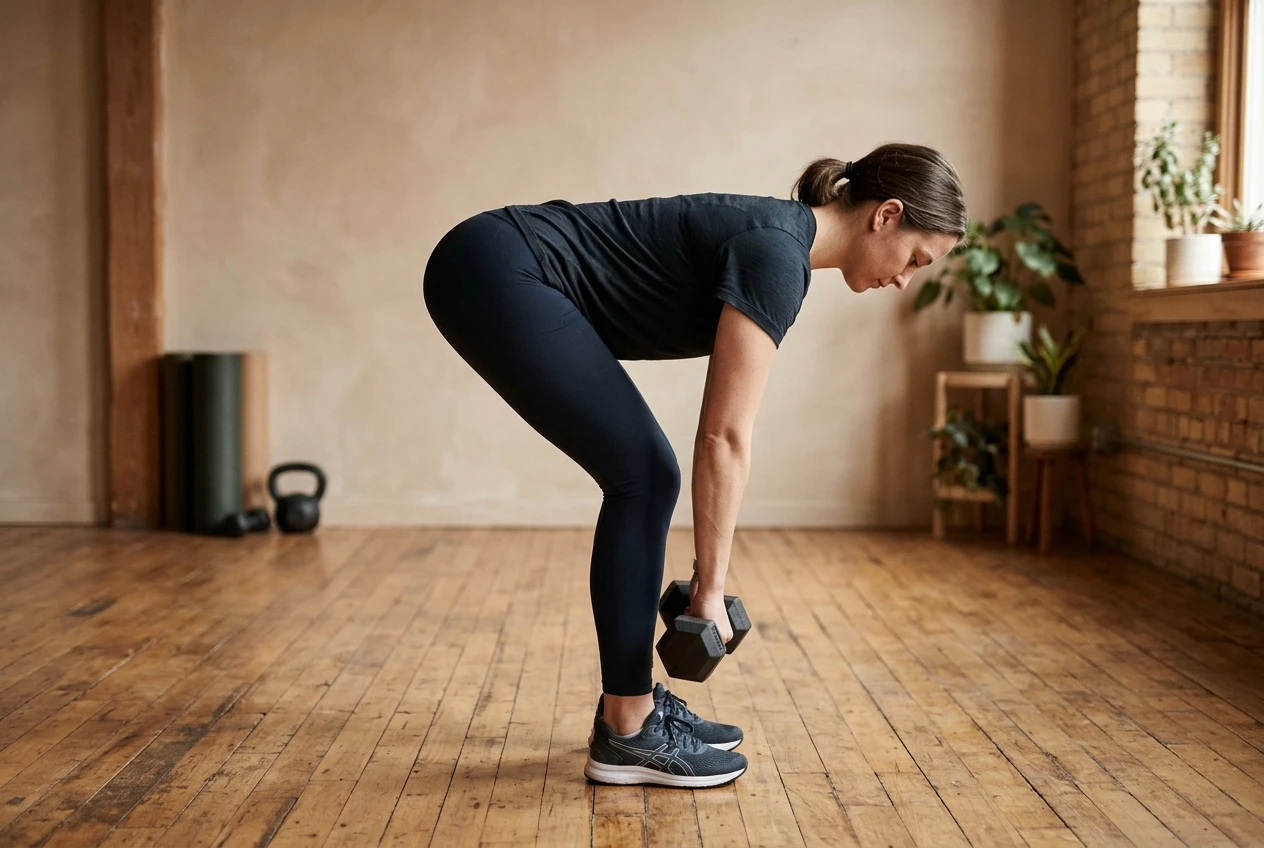
Go down until you feel a strong stretch in the back of your thighs, usually somewhere around mid-shin. Then squeeze your glutes and drive your hips forward to stand.
To keep your back flat, pick a spot on the floor a few feet ahead and keep your gaze there. Don’t tuck your chin or crane your neck up. If your back rounds before you feel the stretch, shorten the range and stop higher.
Push: floor press and dumbbell overhead press
Start with the floor press. Lie on your back with your knees bent and feet flat. Hold the dumbbells over your chest with your palms facing your feet.
Lower them until your upper arms touch the floor, then press back up. The floor stops your elbows from dropping too deep, which makes this a friendly exercise for your shoulders.
Next, the overhead press. Stand tall, with the dumbbells at shoulder height and your ribs pulled down. Squeeze your glutes, then press the weights straight up until your arms are straight.
Don’t lean back to finish the rep. If you do, the weight is too heavy for today. Drop down a bit or do the press seated on a chair.
Pull: one-arm row using a chair or bench for support
Place one hand and the same-side knee on a chair or bench. Let the other hand hold the dumbbell, with your arm hanging straight down. Your back should be flat, roughly parallel to the floor.
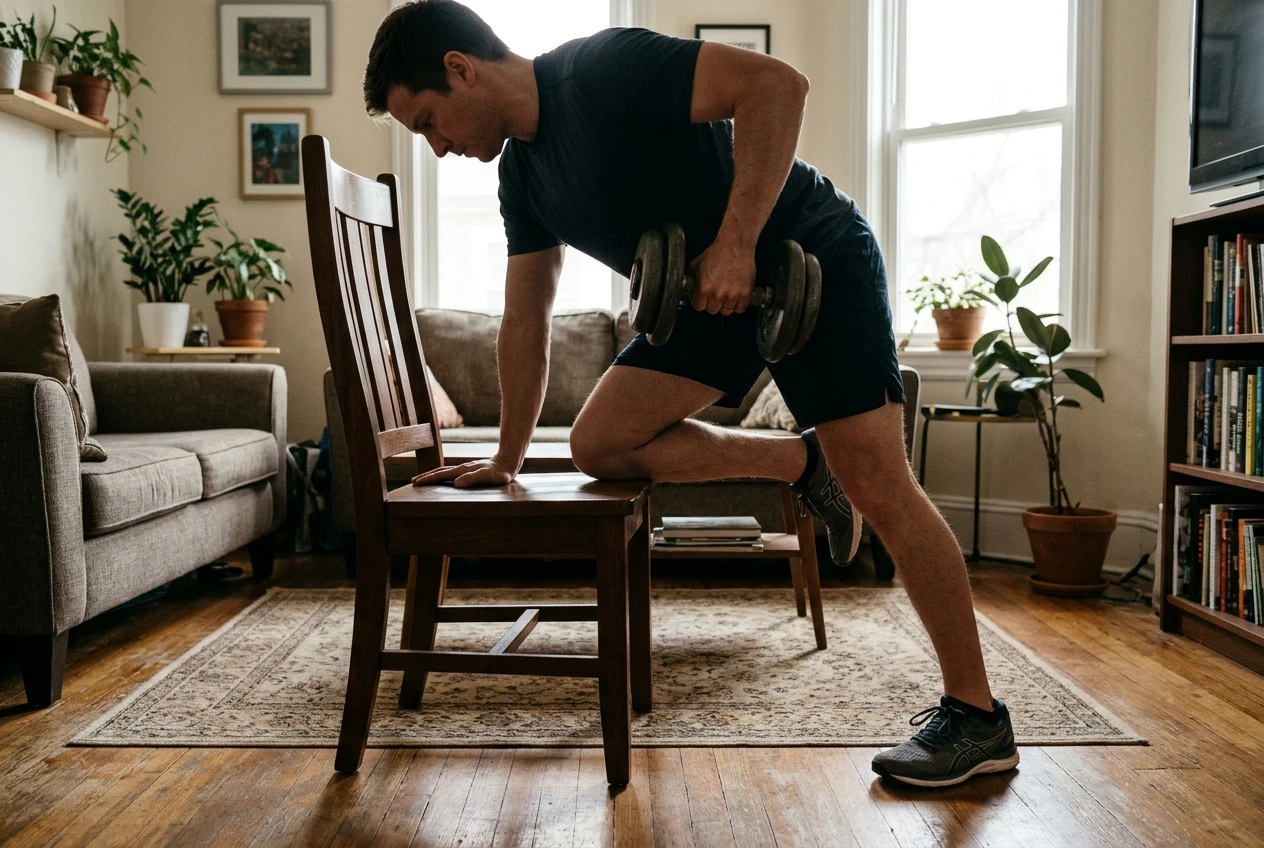
Pull the dumbbell toward your hip, not straight up to your shoulder. Think about moving your elbow back and up, as if you’re starting a lawn mower. Then lower it slowly.
Do all your reps on one side, then switch. Pause for a moment at the top and notice your shoulder blade. If your torso twists as you pull, the weight is too heavy or you’re rushing.
Rows are also your main answer to the missing pull-up bar, so don’t skip them.
Carry and core: suitcase carry or farmer’s walk in a small space
For a farmer’s walk, hold a dumbbell in each hand at your sides and walk. For a suitcase carry, hold one dumbbell in one hand and walk with it. The suitcase carry works your core harder, because your trunk has to resist leaning toward the weight.
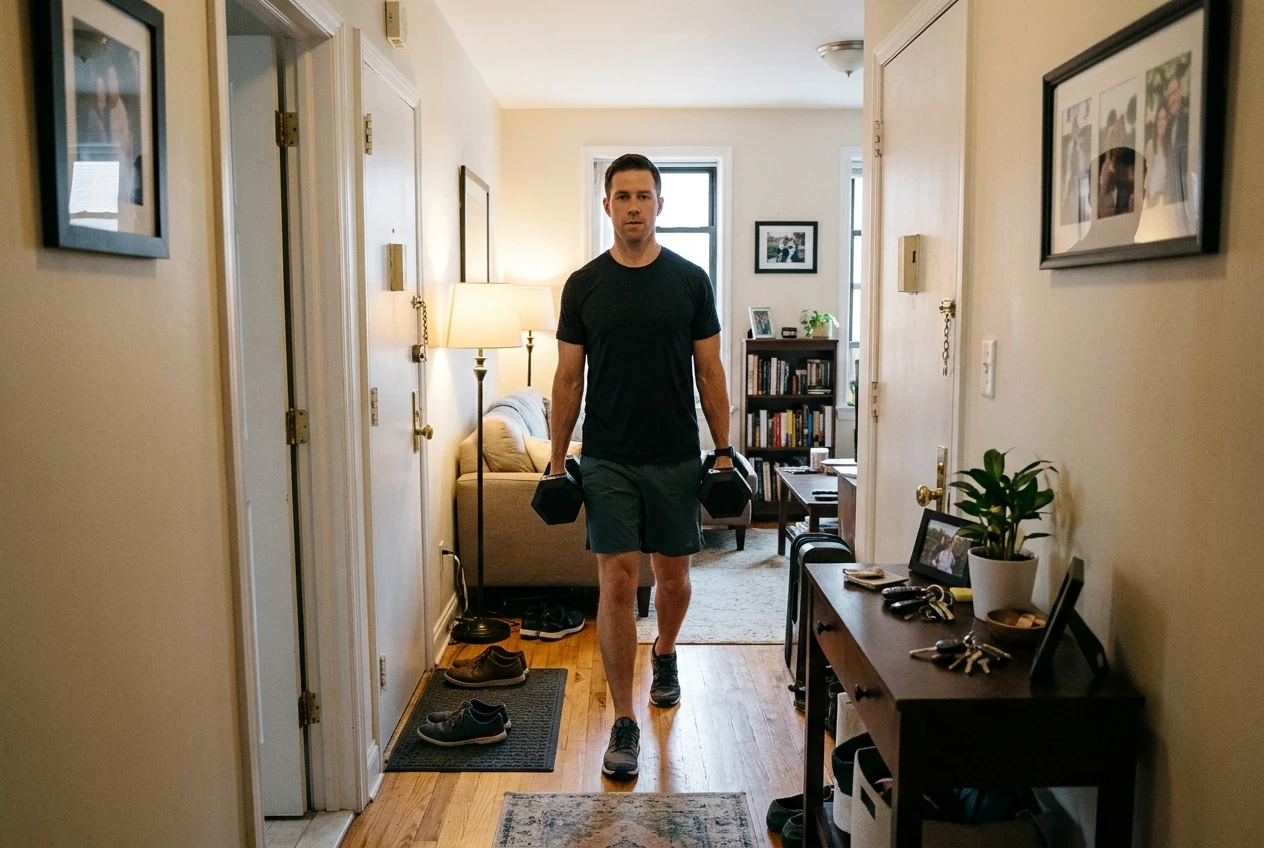
Stand tall, shoulders down, ribs stacked over your hips. Take slow steps and don’t let the dumbbell swing.
In a small space, walk a few steps, turn around slowly and walk back. You can also march in place while holding the weights. The goal is time under tension, not distance.
Putting it together: sets, reps and rest for a 30 minute session
Here’s the whole session. Warm up for about three to five minutes first, with easy bodyweight squats, hip hinges and arm circles.
Then do three rounds of this:
- Goblet squat, 10 reps
- Romanian deadlift, 10 reps
- Floor press, 10 reps
- One-arm row, 10 reps each side
- Overhead press, 8 reps
- Suitcase carry, 30 seconds each side
Rest briefly between exercises, just long enough to set up the next one. Take a longer rest of 60 to 90 seconds after each round. Stop each set with a couple of reps still in the tank. That’s how you build strength without wrecking yourself for the next day.
Do this two or three times a week, with a rest day between sessions.
How to progress when the weight starts feeling light
You’ll know it’s time to progress when you finish every set of an exercise and feel you could have done four or more extra reps.
Try these in order:
- Add reps, working up to 12 per set.
- Slow the lowering part to a three-second count.
- Pause for a second at the hardest point, like the bottom of the squat.
- Add a fourth round.
- Move to single-leg versions, like split squats or one-leg Romanian deadlifts.
Only after that is it worth buying heavier dumbbells. Write your weights and reps down after each session, so you can see what actually changed.
Mistakes that waste your time and how to fix them
The first mistake is rushing. If you swing the weight, momentum does the work instead of your muscles. Count a steady two seconds up and two seconds down.
The second is going too light and stopping far from fatigue. If every set feels easy, use the progression list above.
The third is rounding your back on the hinge and the row. Shorten the range and keep your gaze fixed on one spot.
The fourth is skipping the warm-up and cutting the rest. A short warm-up makes the first round better, and a proper rest makes the last round stronger.
The fifth is changing the routine every week. Repeat this session for a few weeks before you swap anything, because you can only see progress when the workout stays the same.
Call to action
Pick a day this week, set a 30 minute timer, and run this full body dumbbell workout at home from start to finish. Write down your weights and reps when you’re done.
Then repeat it in a few days and try to beat one number, whether that’s a rep, a pause or a slower lowering phase.
If this helped, subscribe so you can follow the rest of the series, and watch the next video on this channel for more ways to train at home with minimal equipment.